BuildingConnected sorts your invites. SmartBid forwards them. Neither one tells you whether you should bid the job, what your win rate is at that GC, or what you owe the architect on Friday. We do — and the won bid lands as your next project, not as another spreadsheet to start over.
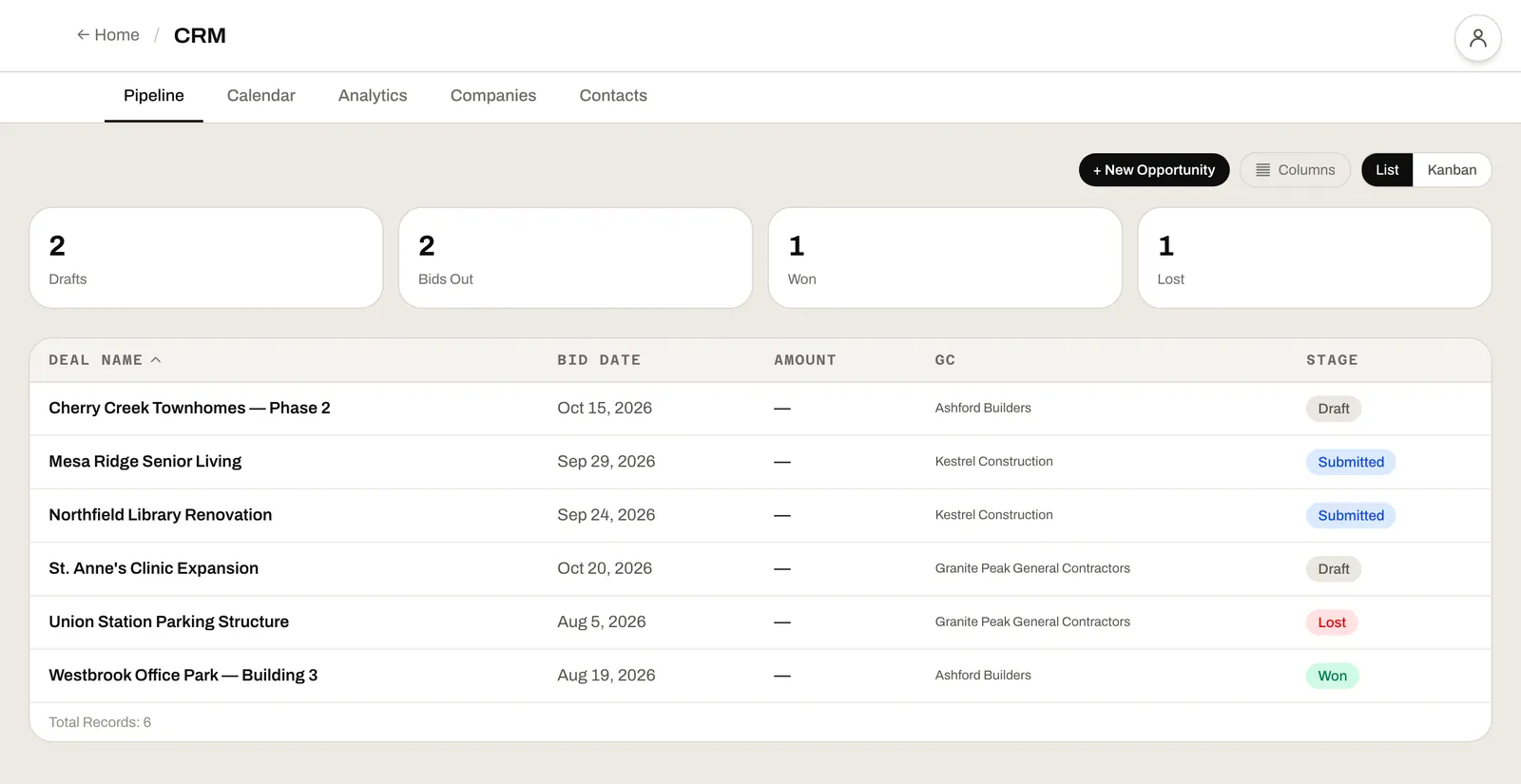
Subs don't have a "sales pipeline" in the SaaS sense. They have a bid pipeline. Invites land in someone's inbox, you decide whether to bid, you submit, you win or lose, you adjust. Force that into a generic CRM and every workflow gets re-invented to fit somebody else's data model.
We built a CRM around the way GCs actually invite, the way you actually decide, and the way you actually track who you've worked with — and how it went.
Built around the bid invite — not around lead-gen forms, not around marketing funnels, not around sales reps with quotas. The workflows that match your day.
Companies and contacts categorized by role — the relationship map your business actually runs on. Not a generic "lead" table.
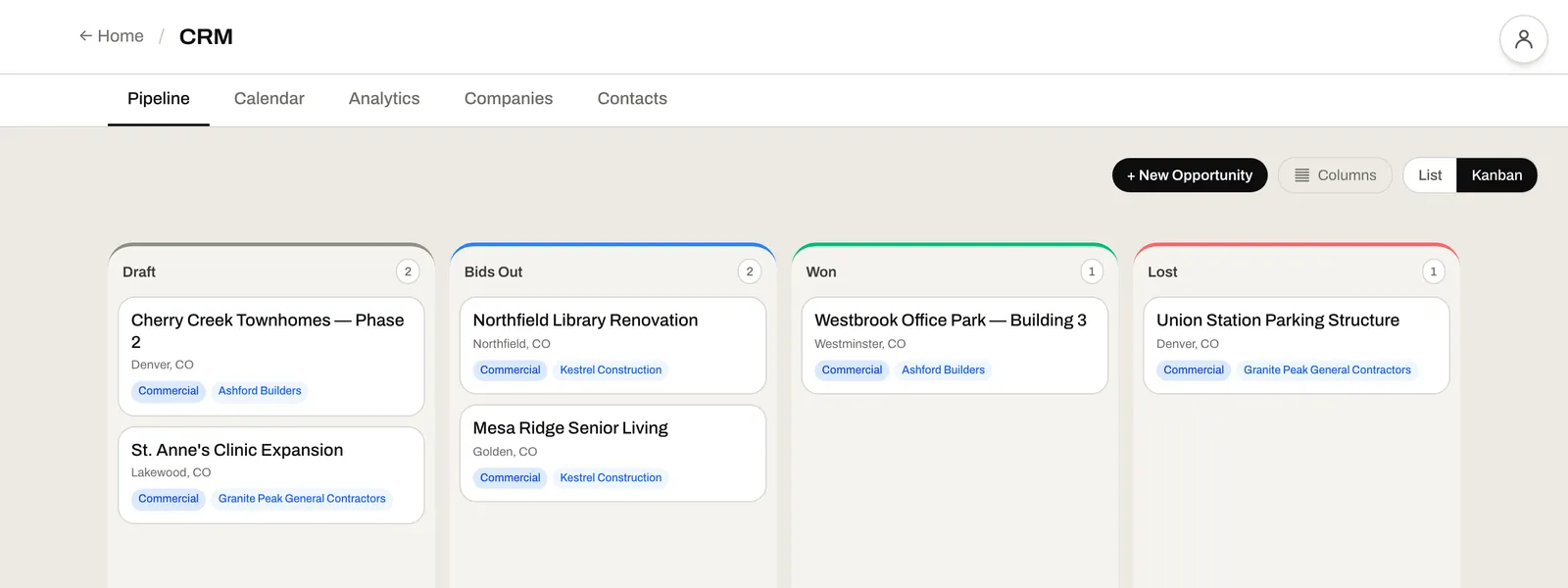
Draft → qualified → submitted → won, lost, declined. Pipeline value by GC, by scope, by month. Win rate trending up or down. The view your bid manager actually needs before Monday's meeting.
Six criteria — capacity, capability, profitability, relationship, geographic, bonding. One decision threshold. The framework no other construction CRM ships with, and the single feature that pays for the system in the first quarter.
Tag every lost bid: price, scope, relationship, capacity, no-bid, other. Quarterly reviews finally have data behind them.
Tasks tied to companies, bids, or contacts. Nothing falls through the cracks because it lived only in someone's inbox.
Win rate by GC, by scope, by estimator, by zip code, by bid size. Spot the GCs you should be chasing harder — and the ones you should be politely declining. The opposite of bidding harder because the year is ending.
A bid invite lands in the CRM as an opportunity. Go/no-go runs. If go, the estimate is built. Win the bid and the opportunity becomes the project — with everything you know about that GC, that architect, that scope already attached.
Every invitation lands as an opportunity. Tied to the GC, the architect, the project address, the scope. Past relationships visible at a glance.
A go decision triggers the estimate. The CRM holds the bid context; the estimator builds the numbers. No re-keying.
Win the bid, the opportunity becomes a project. PMs inherit the GC contact, the bid scope, and the won estimate as the starting baseline.
Know your win rate, not just your win count. Spot the GCs that pay on time, the scopes that win consistently, the work you're losing money chasing.
Manage the bid queue. Decide go/no-go on the work that's worth it. Stop chasing the work that isn't.
Track relationships across every GC and architect in your market. See the pipeline, not just the inbox.
Yes. We migrate your contacts during onboarding from CSV, Excel, or another CRM. Companies and contacts are categorized by role as part of the import.
Email parsing for BuildingConnected and similar platforms is an advanced feature we roll out by tier. Talk to us about your inbox volume and we'll walk through the fit.
Yes. Tasks can be tied to a company, a contact, or a specific bid card. The backlog view shows everything owed across the whole pipeline.
The CRM is where the estimate starts. A go decision pulls the bid context into a new estimate without re-keying — GC, scope, address, due date all flow through.
Won bids become projects. The CRM holds the relationship history so when that GC comes back with another invite, you've got their full bid history right in front of you.
Book a 30-minute consultation and we'll walk through how your bid invites, your GC relationships, and your win-rate data would land in the CRM — using your active pipeline.